 Mystelle
Death tarot meaning: what the card really says
The Death tarot meaning has nothing to do with anyone dying: this card does not predict death, illness or harm, for you or anyone else. Major Arcana number 13 is about endings, transformation and renewal, the moment something that's finished gets to be finished, and what that makes room for.
- Arcana
- Major Arcana
- Keywords
- Endings · Transformation · Renewal
- The card’s message
- Let something old fall away so something new can grow.
The card people are afraid to turn over
Let's get the fear out of the way. In tarot, the idea that this card foretells a death is a myth, one that films have done a lot to spread. Many old decks didn't even print a name on the thirteenth card, as if the makers knew the word would get in the way.
What it speaks of is the ending that makes room. Think of the flat you finally clear out after a long relationship, or the morning you admit that a role finished months ago and only your calendar hasn't heard. Tradition links number 13 to Scorpio, the sign of deep change, and once you look at it squarely it often comes as a relief.
A slow horse and a white rose
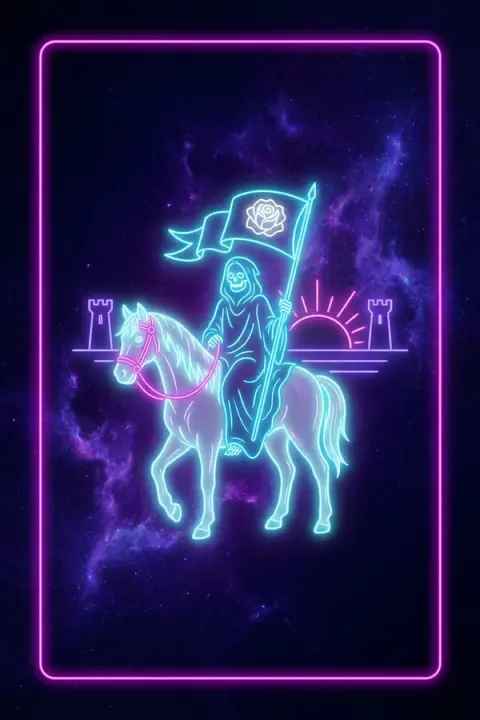
There's very little on the Mystelle card, a few neon lines on a night sky, and the emptiness is part of its calm. A hooded skeleton in a long robe rides a pale glowing horse at a walk, one foreleg lifted, the reins held loosely in one hand. Many old images crowd this scene with fallen figures, so look at the ground: here nobody is underfoot.
The rider's other hand carries a tall pole with a dark flag, and at its centre is a white rose. A skeleton carrying a flower across an empty plain, at walking pace, is a long way from what the name makes you expect.
Behind them is a flat horizon with two small towers, like a gate, and half a sun with its rays between them. Tradition says it's rising. The picture lets you wonder, which seems about right for anyone in the middle of a change.
Upright: when something is already over
The upright card usually describes something that has already ended and hasn't been told. You stop being “the one who always organises” and find that the group survives. You box up the things from a life you were going to have, and it's sad, and it's also lighter.
Its renewal is real but it doesn't hurry, and that horse won't gallop for anyone. There's often a flat stretch between what's gone and what's next, and that stretch is part of the card and no sign that anything's wrong.
Death reversed: the room kept as it was
Reversed, the ending is being refused. The room stays exactly as it was, and you go on paying the membership of an old self. Underneath there's often a fear that nothing comes after this, which is a reasonable fear and one to say aloud to someone.
It can also go the other way: cutting everything at once in a single weekend, so that at least you're the one holding the scissors. That looks like bravery and it's often panic. Both versions are trying to avoid the slow part.
Love: has the last one ended in you?
For a couple, it doesn't forecast parting. More often an old version of the two of you is ending: how you were at twenty-five, the roles you've outgrown, the way you used to fight. Reversed, you may be holding on to that older version while the real people have moved on, and it can help to talk about who you are now.
On your own, the card's question is where the last relationship has ended: in you, or only on paper. You might find the answer in who you still imagine telling your news to. Nothing here says when that changes, and it takes as long as it takes.
Career and purpose: what you've outgrown
A role, a project or an identity may be winding down, even if your job title hasn't changed. Look for the things you still do only because you've always done them, or the skill you're known for that no longer interests you. Direction often returns once some of that has been set down.
This card never tells anyone to quit, which is your own decision, on your own evidence. It only asks you to be honest about what's finished.
One thing that belonged to someone you used to be
Give away or throw out one small thing that belongs to someone you no longer are. An old lanyard will do. If you're grieving a person, please set this practice aside: this card doesn't explain a loss or make it mean something, and you deserve real company in it, from a friend, a counsellor or a local helpline.
- What has already ended and hasn't been told?
- What am I keeping alive from habit?
- What's waiting for the room?
Questions people ask
Does the Death card mean someone will die?
No, it doesn't, and no tarot card can tell you that. The belief is a myth. In tarot, this card stands for change and endings of a very ordinary kind. If you're frightened for someone, or for yourself, talk to a doctor, a person you trust or a local helpline.
Is the Death card a yes or no?
Usually “no” to carrying on as things were, and “yes” to something changing. That makes it an awkward card for such questions. Try asking instead what has come to an end in the situation, and what could start if you let it.
What does the Death card mean for feelings?
A sense that a chapter is over, often with relief mixed into the sadness. Someone might feel they've changed, or be done with how things were, without any clear idea of what comes next. It says nothing about what they'll do, and you can ask them.
Is Death the worst card in the tarot?
It has the worst reputation and, among experienced readers, one of the better ones in practice. Many welcome it, since it says that something stuck can finally move. No card in tarot is a curse, and this one is mostly a slow horse and a rose.