 Mystelle
Justice tarot meaning: an honest account
An honest account of what happened, who did what and which part is yours: the Justice tarot meaning comes down to that. Fairness, truth and balance are the themes of Major Arcana number 11. It can't say how a court case will go. Upright or reversed, it asks you to tell the story straight, including to yourself.
- Arcana
- Major Arcana
- Keywords
- Fairness · Truth · Balance
- The card’s message
- Be honest with yourself and others; balance comes from clear truth.
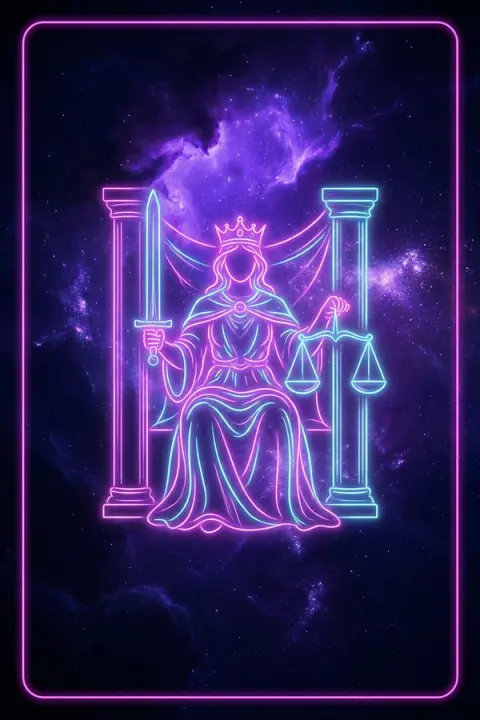
The story without the sympathetic nod
Try telling the story of a falling-out to someone who knows neither of you and won't nod in the right places. You'd probably have to mention the message you sent in March. Justice is that listener, and how the story makes you feel about yourself is of no interest to it.
It's number 11 here, though many older decks put it at 8, and it's one of the old virtues in the deck alongside Strength and Temperance. Tradition links it to Libra, the sign of the scales. At heart it's a card of cause and effect: how you act matters, and the accounting isn't someone else's job.
The blank oval
Under the crown there is no face. The Mystelle card draws a blank outline where the eyes, nose and mouth should be, and once you've seen that you can't stop looking at it. There's nothing to charm and nothing to read, no favourite in the room, and no way to tell how you're doing.
The figure sits in a long draped gown between two plain neon columns, the left one magenta and the right one cyan, two sides with equal standing. A curtain hangs between them. One hand holds a sword straight up, its blade in cyan, and with a double edge it cuts toward you as readily as anyone else.
The other hand lifts a pair of scales with the pans dead level. You come to this card for a verdict and the empty oval gives you nothing back, which has a way of sending the question home.
Justice upright: saying who really did what
Here you say out loud who really did what on the group project, including the part that doesn't flatter you. Or you go back to a friend, three weeks late, to say “I got that wrong”, with no “but” after it.
Fairness also points at yourself. You may be holding yourself to a standard you'd never apply to a friend in the same spot, and that's inaccurate as well as unkind. The card's taste is for truth, and truth includes the things you did right.
Justice reversed: excuses with footnotes
Usually this is a story you're telling yourself about why it's fine: excuses with footnotes. It can also be a real unfairness you've been living with for so long that you've stopped calling it that. Neither of those means some injustice is on its way to you.
Then there's the inner court that never rises, verdict after verdict on yourself at two in the morning. Or you may have sentenced someone else before hearing the second half of the story. In each case more evidence tends to help, and so does a kinder judge.
Justice in love: who carries what?
Count your standards. If you're single, it's easy to have a long list for a date and a short one for your own behaviour. This card is also good at asking what you want from someone, put plainly enough to be fair to them.
Between partners, the question is who carries what: the remembering, the planning, the emotional upkeep. Has anyone ever said it aloud? Reversed, the ledger has come out, complete with entries from last March. No card can tell you to go or to stay, and this one asks only that you tell the truth about how things stand.
Credit where it's due
At its best, this card is fair credit, straight feedback and decisions you could explain to the person they affect. Naming your own mistake before anyone finds it is a very Justice thing to do, and people remember it. Direction comes from here as well, in being able to stand behind what your work does.
When the card is reversed, blame is being passed around the room and politics has replaced evidence. You may not be able to fix that, but you can keep your own account accurate.
Write it from their side
Write a recent dispute from the other person's side, in the first person, as fairly as you can manage. You don't have to agree with it or show it to anyone.
- Which part of this is mine?
- What would I say if a friend had done this?
- Whose account am I still keeping, and who asked me to?
Questions people ask
Does the Justice card mean I'll win my court case?
No card can tell you anything about a legal outcome, and this one is no exception. For a real case, ask a lawyer. Justice speaks of honest conduct and looking at your own part, and that's worth doing whatever happens in any courtroom.
Is Justice a yes or no card?
Yes, if what you're asking for is fair. The answer depends on the facts, which means it may be a no if you already suspect you're in the wrong. It tends to give you the reply you'd give a friend.
What does Justice mean as a person?
This person will tell you honestly that you were out of line, then help you fix it. You'll always know where you stand with them, and they can seem a little cool. They may need reminding that being right and being kind are two separate jobs.
What's the difference between Justice and Judgement?
Justice, number 11, looks at what you've done and what follows from it, in the plain light of day. Judgement, number 20, is about being woken up and called to something next. One is an audit and the other is an alarm clock, and both can be good news.