 Mystelle
Ten of Swords tarot meaning: when something is finally over
The Ten of Swords tarot meaning is an ending: something has run its course, it hurt, and it's done. It doesn't predict death, harm or disaster; that fear is a myth. The air suit's last number is about letting go, and a new dawn. If you're worn out, you don't have to admire it yet.
- Arcana
- Minor Arcana
- Suit
- Swords
- Element
- Air
- Keywords
- Endings · Letting go · New dawn
- The card’s message
- The hardest part is behind you. A new day is already rising.
The count runs out
Maybe you've carried the last box out, or the final decision came through yesterday. You've stopped arguing, since there's nothing left to argue with and you're so tired. That mix of hurt and relief is hard to explain to anybody, and this card knows about it.
Ten is the last number in a suit of the Minor Arcana, the point where a thing can't go any further in that direction. After it the count starts again from the Ace, in its own time.
The swords stand behind, and nothing touches
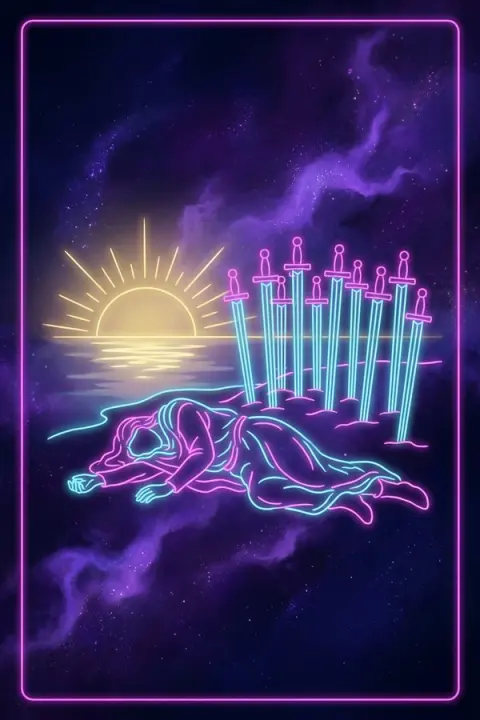
Many people know this card as a body pierced with blades, and the Mystelle card is different. A figure lies on their side on a shoreline, wrapped in a cloak, face hidden against one arm, and a row of ten tall swords stands upright in the ground behind them. None of them touches the person. Whatever those blades were, they've landed, and they've stopped.
This could be sleep or it could be exhaustion; the picture doesn't say. One hand lies open on the sand, no longer gripping anything.
To the left a large half sun sits on the horizon, with long rays and gold ripples on calm water, the only gold on any card in this suit. Dawn comes unearned and asks you for nothing. It isn't asking you to get up.
Upright: done, and so tired
This is the day after, when you wake up and remember. A long strain has ended, and you're not yet anyone in particular. The picture's mood is that the hardest part is behind you and a new day is already rising. That's no promise about your week, and it doesn't say you deserved this or that it was for the best.
For now, the useful things are small: let a friend know, go to bed at a sensible time. If it's too much to carry, please talk to someone you trust or a local helpline, today if you can. Getting up comes later, and nobody's counting.
Reversed: getting up in stages
The reversed card is often read as getting up slowly, with setbacks. You have a decent morning and then a terrible Thursday, and that doesn't mean you've gone backwards.
It can also describe refusing to let a thing be over: one more try, a story that keeps needing a new last chapter. Or a bad week may feel like the end of everything, which deserves to be taken seriously, and which may look different after some rest.
In love: what has actually finished
This card makes no forecast about who stays or who goes. In a couple it may be a pattern that's finished, an old fight you've both run out of energy for.
Without a partner right now, you may find one ending has become the whole story of you, the one you tell first. It was real, and it's allowed to take up room. Reversed, you may be starting to wonder what else there is to say.
No plan on day one
A project, a role or an idea of yourself has ended, and everyone wants to know what's next. You don't need a plan on day one. Purpose tends to come back sideways, from small things you find you still care about.
Today's date and one line
Write today's date and one line: “This part is over.” Then do one small ordinary thing, like a walk, a call or a meal. That's enough for one day.
- What's actually finished?
- What's the smallest thing I can do today?
- Who can I call?
Questions people ask
Does the Ten of Swords mean death or disaster?
No. It's the card people dread most in this suit, and the idea that it foretells death, ruin or harm is a myth. It describes a stage of something coming to an end.
Is the Ten of Swords the worst card in tarot?
It often gets called that, and it's not a comfortable one to turn over. Look at what it shows, though: the blades have stopped, and it's morning. There's an honesty in a card that admits how bad something was.
Is the Ten of Swords a yes or no card?
A “no” that's final, which can come as a relief after a long maybe. This particular thing, in this form, has run out. Feelings in this card tend to be exhaustion more than drama: someone worn out, with nothing left to argue with.