 Mystelle
The Hierophant tarot meaning: who taught you that?
Ask who taught you what you know and you're already close to The Hierophant tarot meaning. Tradition, learning and guidance are its themes, and it's number 5 in the Major Arcana. Upright, it says wisdom handed down to you has something useful in it. Reversed, it asks which rules you're still following out of habit.
- Arcana
- Major Arcana
- Keywords
- Tradition · Learning · Guidance
- The card’s message
- Wisdom passed down to you holds something useful right now.
A word you need a teacher for
It's pronounced HIGH-er-oh-fant, and the fact that most of us had to look that up is a fair introduction. The word comes from the Greek for someone who shows sacred things, and older cards simply call him the Pope. Yet the card reaches well past religion: a guild, a school, a dance class, a family's way of doing Christmas.
Its subject is how knowledge gets from one person to the next. Number 5 in the Major Arcana, linked by tradition to Taurus, it's the counterpart of The High Priestess: what she knows in silence, he teaches aloud. An old family recipe, followed to the letter once before you change it, is this card in a kitchen.
Keys on the floor
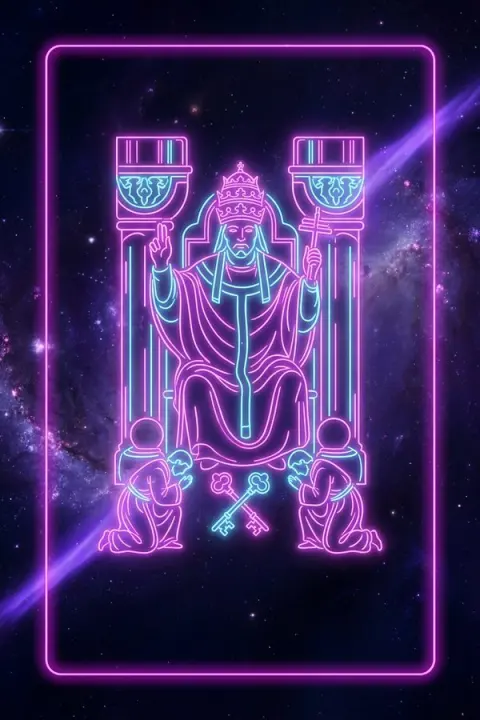
A bearded figure in a triple crown and a heavy robe with a long stole sits under an arched throne back in the Mystelle deck, framed by two thick columns. One hand is raised with two fingers up in blessing, something being passed along, and the other holds a staff topped with a cross. Behind the whole scene a diagonal band of violet light, like the Milky Way, cuts across the card, a reminder that the sky is considerably bigger than any building that claims to explain it.
Two small kneeling figures have their backs to us, so you're effectively in the row behind them, waiting as well. Now find the keys. They lie crossed on the floor in bright cyan neon, between those two figures, at the height of the students and well below the master's hand. Keys stand for knowledge that opens things, and what he guards here looks as though it's meant to be picked up.
Upright: finding a teacher
Upright, this is the card of the sixth tutorial video, when you admit you need an actual person to watch your hands and correct them. It's also the oldest colleague on the team, asked why it's done this way, giving an answer that saves you a month.
There's something reassuring about it: you don't have to work everything out alone, since people have been at this for a long time. A tradition, at its best, is a lot of old mistakes that someone has kindly saved you from. Learn the rules properly and you'll know which ones can bend.
Reversed: Sunday lunch, out of guilt
Here the form has come away from the meaning. You're at Sunday lunch every week out of guilt, nobody enjoys it, and no one dares to be the first to say so. Or a teacher has stopped listening, and asking why is treated as rudeness.
Look inward too. You may be reciting opinions you picked up at twelve and have never examined. There's an opposite trap as well, rebellion as a reflex, where something gets thrown out only because it's old, and you lose a good recipe along with the bad rule.
The Hierophant in love: whose script is this?
Someone told you what love ought to look like by thirty. If you're single, find out who, and see if you agree. This card can also speak for people who actually like convention, and want things declared, introduced to the family and done properly.
Between partners, it asks what your rituals are and what you've promised each other, spoken or not. Reversed, you may have something that works beautifully and doesn't fit the family's script, and that's a good thing to say aloud to each other. Tradition links the card to formal commitment, but it doesn't forecast a wedding.
Career and craft: learning the house way
Mentors, apprenticeships, qualifications, learning how things are done here before you try to change them: this is the card's territory. Sooner or later it also turns the question round, and you find that you're the one with something to pass on. Teaching a junior colleague is one of the most direct ways to learn what you know.
The reversed version says “we've always done it like this” to close a conversation. That sentence isn't always wrong, but it should be able to survive a follow-up question.
Ask someone older how they do it
Ask an older person one how-do-you-do-that question today, about anything from pastry to a hard conversation. Write the answer down in their words.
- Who taught me this, and would I choose it now?
- What would I learn faster with a teacher?
- Which of my rules did I inherit?
Questions people ask
How do you pronounce Hierophant?
HIGH-er-oh-fant, with the stress on the first syllable, and you'll also hear high-ERR-oh-fant. It comes from ancient Greek, where it was the title of a priest who showed sacred objects to initiates. Nobody in a tarot class will mind if you stumble over it.
Does The Hierophant mean marriage?
Its links with vows and ceremonies mean people ask this a lot. It makes no prediction about weddings. It's more useful as a question about what commitment means to you, and whose idea of it you're working from, than as news about anything on its way.
Is The Hierophant a yes or no card?
A yes, by the established route. It favours doing things in the proper order, with advice from people who've done them before. If your plan depends on skipping every step, expect a raised eyebrow from this card, and maybe two raised fingers.
What does The Hierophant mean as a person?
A mentor, teacher, priest or senior colleague, of any gender, who knows how things are done and enjoys explaining it. Good ones welcome your questions. A simple test of any such person is what happens when you ask why: if that's a problem, you've learned something.